
Payroll Services in 2026: Costs, Coverage, and How To Choose One

Updated August 2, 2026
Providers pay us a referral fee when a match is sent to them. Routing rules don't change based on who pays, and some results route to options that pay us nothing. How PayGenie makes money
What a payroll service does
A payroll service calculates pay, moves the money, and files the tax returns. Your filings go out under your own EIN, and your people stay employed by you.
What's usually included
- Most payroll services handle gross-to-net calculation and pay distribution, withhold and remit federal, state, and local payroll taxes, file Form 941 each quarter and Form 940 annually, produce year-end Forms W-2 and W-3, process garnishments, and file new hire reports. Federal tax deposits must be made by electronic funds transfer, and your payroll service handles that for you.
What's not always included
- HR advice, employee handbooks, compliance monitoring, workers' compensation placement, and timekeeping vary quite a bit from one company to the next. Some include them, some sell them as add-ons, and some don't offer them at all.
Benefits are the common exception. Plenty of payroll services offer health, dental, and retirement plans as an add-on.
What's included varies enough that two companies describing full-service payroll can cover meaningfully different work.
What payroll services cost
How the pricing works
Payroll services charge a monthly base fee plus a fee per employee. Base fees run $40 to $150 and per-employee fees run $4 to $15.
Here's how that adds up at a $75 base fee and $8 per employee, near the middle of the market:
| Employees | Base fee | Per-employee fees | Monthly total | Cost per employee |
|---|---|---|---|---|
| 3 | $75 | $24 | $99 | $33.00 |
| 12 | $75 | $96 | $171 | $14.25 |
| 25 | $75 | $200 | $275 | $11.00 |
| 40 | $75 | $320 | $395 | $9.88 |
Because the base fee stays flat, a 40-person company pays roughly a third as much per employee as a 3-person company. A single per-employee price quoted without the base fee hides this, which is why quotes are hard to compare until you've annualized both.
What's billed separately
Implementation runs $200 to $1,000 depending on the size of the company being set up. Commonly separate line items:
- Off-cycle payroll runs
- Year-end W-2 processing
- Filings in additional states
- Amended returns
- Garnishment setup
Contract terms
Across our provider network, most agreements run 12 months with a 30 to 60 day notice window and automatic renewal. Switching later means moving your payroll history to the new company, which is worth asking about before you sign.
Rates are current as of August 2026 and change annually. Verify against the linked source before relying on them.
How many hours payroll takes
These are rough averages for a company running payroll twice a month, meant as an example rather than a benchmark. Your own hours will depend on how complicated your payroll is.
The table below holds headcount at 10 employees and changes only how complicated the payroll is, because complexity, not headcount, is what actually drives the hours.
| 10 employees, all… | Approximate hours per year |
|---|---|
| Salaried, one state | 45 |
| Mixed salary and hourly, one state | 70 |
| Mostly hourly, one state | 95 |
| Hourly, split across 2 or more states | 140 |
Hours cover the runs themselves, the quarterly returns, and year-end W-2 preparation.
What makes it take longer
Hourly pay adds time to every run, because hours vary and someone has to collect and check them. Tipped wages, multiple pay rates, garnishments, and contractors paid alongside employees add more on top.
A second state adds the most. Each one brings its own registration, its own filing calendar, and its own returns, and none of that shrinks as a company adds states. The same 10-person company can go from 45 hours a year to 140 without a single employee added, just by spreading across state lines.
The filings and deadlines a payroll service handles
Running payroll is mostly about hitting deadlines, and this is the part a payroll service takes off your desk. You stay legally responsible for your company's payroll taxes either way.
1. Deposit schedules
There are two deposit schedules, monthly and semi-weekly, and you must determine which one applies to your company before the beginning of each calendar year. Which schedule you're on depends on your prior payroll volume, and the rules sit in IRS Publication 15.
Deposits and filings are separate obligations. A correctly filed return still carries penalties if the deposits behind it were late, which is a common way companies handling payroll themselves get caught out.
2. Late deposit penalties
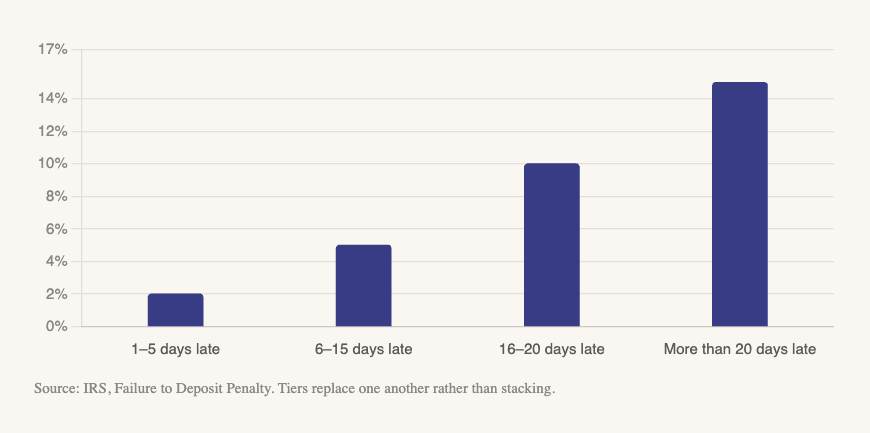
The IRS charges 2% of the unpaid deposit for 1 to 5 calendar days late, 5% for 6 to 15 days, and 10% beyond 15 days. A deposit still unpaid more than 10 days after the first notice carries 15%.
These replace one another rather than stacking, so a deposit 20 days late carries 10% rather than 2% plus 5% plus 10%. Interest accrues on top.
On a $20,000 quarterly deposit, 15 days late costs you $1,000.
3. Other deadlines that carry penalties
- W-2s: due to your employees and to the Social Security Administration by January 31.
- FUTA: deposited for any quarter in which the tax due exceeds $500, payable by the end of the following month.
- E-filing: required once you file 10 or more information returns, counting Forms W-2 and the 1099 series together.
This page explains how payroll and HR service models work. It isn't legal or tax advice. For a decision specific to your company, talk to a CPA or employment attorney.
How to choose a payroll service
Annualized quotes tend to land close together, so the differences that matter are usually elsewhere. Four things worth raising in any sales conversation.
1. Ask what's actually included
Two companies describing full-service payroll can mean different work. Asking for the scope in writing, as a list, is the only reliable way to compare two quotes side by side. Not every company will volunteer one, so it's worth asking directly.
2. Ask about local filings
Nearly every payroll service files your federal returns and your state returns, so those rarely separate one from another. Municipal and county filings are a different story. Plenty of cities and counties levy their own payroll taxes, coverage varies by company and by jurisdiction, and it's worth naming every city and county you have employees in and asking whether they file there.
3. Ask who pays if a filing is late
You remain liable to the IRS regardless of what your contract says. What varies is whether a payroll service will reimburse a penalty it caused, and that's not something PayGenie can generalize across providers. It's worth asking for that commitment in writing before you sign, rather than assuming it's included.
4. Ask who you'll actually be talking to
Service is the main reason companies choose a payroll service over software in the first place, so it's worth finding out what you're getting. A named contact with a stated response time is a very different experience from a general support queue, and that difference almost never shows up in a quote. There's no standard across the industry here, so it's worth asking each company directly rather than assuming.
Worth quoting local companies alongside national ones
National payroll companies bring scale, mature software, and coverage in every state, which matters a lot if you operate across many of them.
Regional payroll companies compete on service, and many of them build their whole business on it: a named person who answers the phone, knows your account, and lives in your state. They rarely appear on software review sites, which index toward national brands, so they're easy to miss.
Our network covers all 50 states and includes both, and quoting one of each is usually worth the extra call.
See which payroll company is right for you.
9 questions, about 2 minutes, then get matched to named providers who fit your company.
Find your match
Frequently asked questions
- How much should a payroll service cost? A monthly base fee of $40 to $150 plus $4 to $15 per employee. A 12-person company typically lands near $170 a month, with implementation of $200 to $1,000 one time.
- What is a payroll service? A firm that runs payroll and files payroll taxes for your company. You stay the employer and keep your own benefits and insurance.
- What's the cheapest option for a small business? Payroll software costs less than a payroll service at low headcount, because the base fee makes up most of what a small company pays. What you give up is the service: with software you're still the one entering the hours, catching the errors, and calling support when a filing looks wrong.
- Can a company with 1 or 2 employees use a payroll service? Yes. Payroll services will take a company with one employee.
- Does a payroll service handle workers' compensation? Some administer a policy you already hold, and some will broker one for you. Providing the coverage itself is uncommon, so it's worth asking what a given company actually does.
- Who is responsible if a filing is late? You are. Whether your payroll service reimburses a penalty it caused depends on your agreement.